Case Study
AI-Powered RFP Document Generation Platform
Turning a manual, multi-day proposal process into a one-click AI pipeline
Overview
Request for Proposal documents are the lifeblood of consulting and services businesses — but assembling them is tedious, error-prone, and slow. RFP Rocket replaced a scattered manual workflow with an end-to-end automation that drafts, formats, and delivers polished proposals in minutes instead of days.
The Problem
The team was spending 8–12 hours per RFP, copying boilerplate across Google Docs, chasing stakeholders on Slack for approvals, and manually updating Asana boards when milestones shifted. Formatting inconsistencies crept in regularly, and deadline pressure meant quality often took a back seat to speed.
8–12 hours per proposal, reduced to under 30 minutes
Designing the Pipeline
I mapped every touchpoint in the existing process — intake, drafting, review, formatting, delivery — and identified where automation would have the highest leverage. The key insight was that most RFP content fell into repeatable patterns: company background, team bios, case studies, pricing tables. The variable pieces were scope-specific, which made them ideal candidates for AI-assisted generation rather than full automation.
Building with n8n + OpenAI
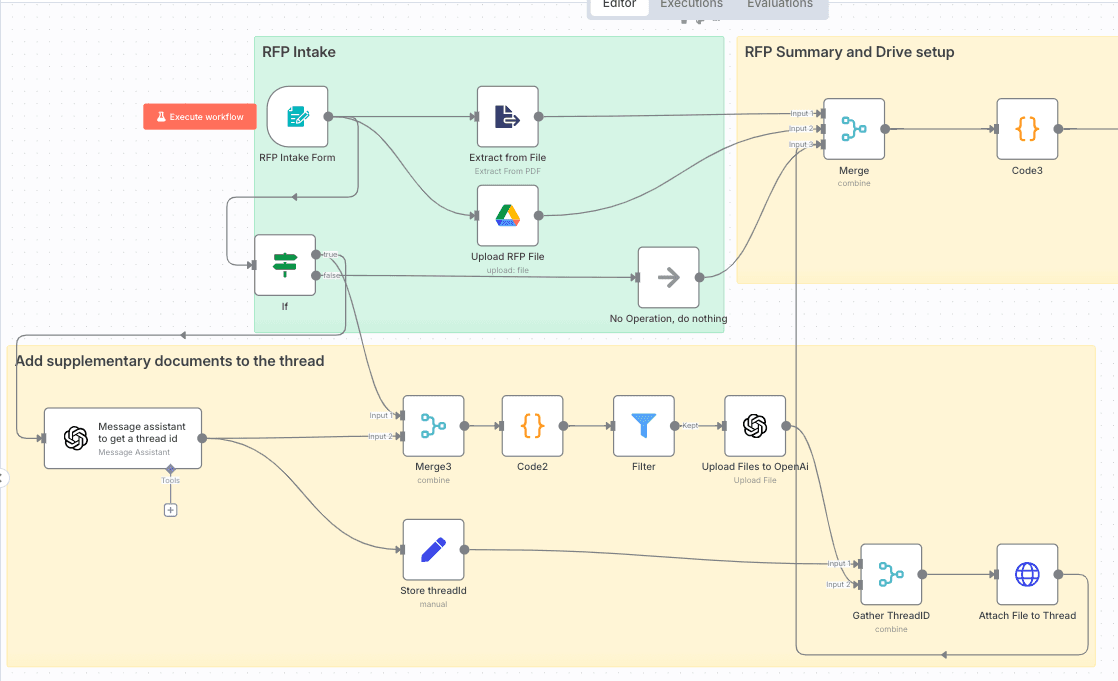
I chose n8n as the orchestration layer because it gave the team a visual workflow they could inspect and tweak without touching code. OpenAI handled the generative work — drafting scope narratives, tailoring case study summaries to the prospect's industry, and producing executive summaries. Each AI call was wrapped in validation logic that checked output structure against a JSON schema before it hit the final document.
Visual workflows meant non-technical team members could adjust prompts and templates
The Integration Challenge
The hardest part wasn't the AI — it was the glue. Slack notifications had to fire at exactly the right moment so reviewers weren't buried in noise. Asana tasks needed to update bi-directionally so the project board always reflected reality. Google Drive permissions had to be set correctly for client-facing folders. I built a retry-and-fallback layer to handle API rate limits from all three services, with alerting that paged the team only when a human decision was genuinely needed.
Quality & Compliance
AI-generated text needs guardrails. I implemented a multi-pass review system: the first pass generates content, the second pass checks it against a compliance checklist (no unsupported claims, correct legal language, accurate pricing references), and the third pass formats everything into the branded template. This gave the team confidence to let the system run with minimal oversight.
Results
- Proposal turnaround dropped from days to under 30 minutes
- Formatting errors eliminated through template-driven assembly
- Team bandwidth freed up for higher-value client work
- Compliance pass rate improved with automated checklist validation